Conservation and repair of an historic lime render – Gloucestershire.

This slideshow requires JavaScript.

The render probably dated from the 19th century. It had replaced an earlier render, traces of which were present here and there. Traces of coloured limewash on the quoins suggested that at one time the quoins were left unrendered as a feature element. The render now covers all the masonry except, of course, for the mullions, although during the project a small window was found beneath the render. The render was generally sound, although there were some loose sections totalling about 20 square metres, in addition there were a few long cracks associated with historic settlement. There was another 20 metres or so of cement based roughcast patches. The whole render was very grimy with a lot of lichen. The first task was power washing to remove the lichen and grime, the washer is not over powerful but enough to dislodge any defective render along the way. All the cement patches were removed and work began on repairing the exposed rubblework. The next task was to apply the first coat of lime render. Mild hydraulic lime was used mixed with a generous amounts of animal hair. The cracks were gently widened and filled with lime mortar. Numerous amounts of nail holes were filled as well as the narrow cracks on the extremities of the render. There were some areas of severe lichen encrustation that couldn’t be removed. These were keyed up to coated with a very well haired roughcast mix. The repairs were roughcast, allowed to set and then given five coats of limewash. The first two coats were unpigmented – the white contrasted well with the black nail and bee holes allowing us to do further filling. Once again a coat of white was applied. A coat of yellow ochre based limewash was applied all over for approval. The client felt that the bold colour was too much and so A fresh batch was prepared with the required modifications, this new colour was felt to be much better and so the fourth colour was applied. The difference in colours, the first colour on white and the second yellow on the first allows one to see what’s been limewashed and what hasn’t, applying the same colour again often to leads to areas being missed or inadequately coated. The render was now thoroughly coated with four layers of limewash, with the colour now approved the final coat was applied. This final coat was easy to apply because every hole had been filled and the rough texture of the roughcast had been reduced to a much more homogenous and gentle texture. The final touch was the repair of the window masonry and the subsequent limewashing of the stone in a contrasting colour. Mixes: Repair mortar for the render – 1 part lime to 2.5 parts sharp sand Reinforced with animal hair. Crack filling – 1 part lime to 1.5 parts fine sand. Limewash – undercoats Lime putty, water, Reinforced with chopped hair, fine polypropylene fibre and silver sand for the first two coats Limewash – Final coats Lime putty, water, yellow ochre and raw umber, tallow.
Posted in Roughcast render | Leave a comment

A simple lime plaster cornice

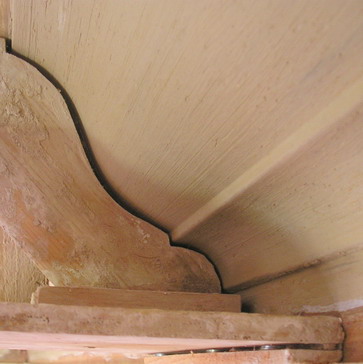
running a cornice in situe

This is in a National Trust property in Gloucestershire, UK. The building is a summer house and tends to be damp in the winter, for this reason I decided to fashion this cornice from lime plaster in situe rather than have a moulding made up in the workshop. It was felt that anything based on plaster of Paris would deteriorate in the damp conditions.  The final mix, seen here, was composed of lime putty, brick dust and sandstone dust. These three ingredients would act upon each other and create a strong plaster, with resistance to shrinkage during the drying and curing period.

The backing coat consisted of Lime putty, sharp course sand and lots of animal hair. This sticky mix was applied to wooden laths fixed between the ceiling and wall at 45 degrees. The lath cradle had the appearance of a railway track running around the room.


Posted in Lime Plaster | Leave a comment

The Gate House

the finished artical

the finished artical

This slideshow requires JavaScript.

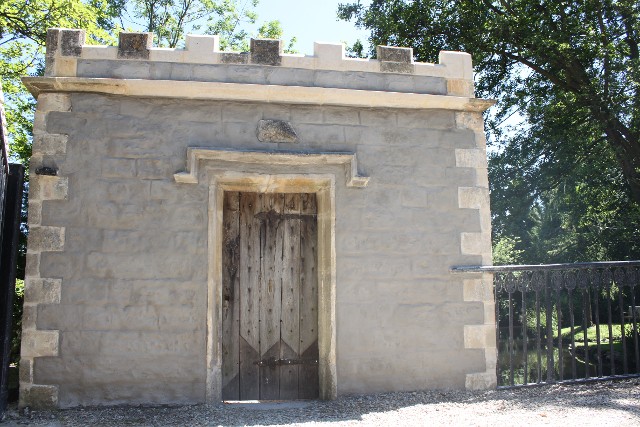
A Gate House by the side of a moat.

A one room building 4 metres x 4 metres built of Blue Lias limestone.

It was in a sorry state with the roof gone and the crenellated parapet in a precarious state. The Cotswold cornice stones and crenulations ready to fall off.

The task was to conserve the building with minimum replacement or disturbance. The main area of concern was the wall surface. Built of cut blocks of rubble faced blue lias lime stone – regularly coursed. Blue lias is a poor building stone and these stones were dire. Normally the building would have been lime rendered this, however, was not allowed. Yet the stones couldn’t be left exposed . There were fist sized holes all over – especially were the ivy had been growing.

We cleaned vigorously, removing all loose material. Every hole was filled with mortar and stone pinnings(off cuts of stone that are used to replace some of the mortar used to fill the holes )Each stone was treated individually so that the edges were maintained. The pointing had been raked out so that each stone was clearly visible.

We lime roughcast rendered the walls. We had included as much animal hair in the mix as possible and coloured the render with black and yellow pigments to get a close colour match with the stone.

Whilst the render was still very wet we carefully brushed it around , working it into the cracks and into the mortar joints, brushing and compacting, brushing off the excess, until the whole surface was encased in a thin reinforced lime render exoskeleton

The render followed every undulation and contour like a tight fitting dress. Afterwards we painted on four coats of blue lias lime coloured lime wash.The result was remarkable. Each stone individually expressed, their surfaces restored to their original rubble faced appearance.

All thoroughly protected.

Building Conserved .

Architecture restored.

Posted in Stone repair | 2 Comments